
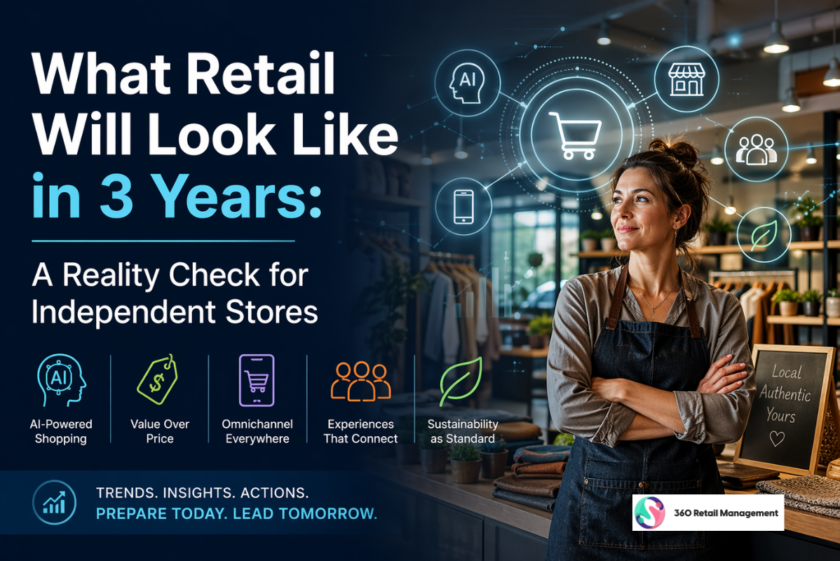
What Retail Will Look Like in 3 Years: A Reality Check for Independent Stores
The retail landscape is undergoing its most dramatic transformation in decades, and for independent store owners, the next three years will be anything but business as usual. Understanding what’s coming isn’t pessimism — it’s preparation, as highlighted in the Deloitte 2026 Retail Industry Outlook.
Independent retailers today don’t need more predictions; they need a clear path forward. At 360 Retail Management, we help store owners turn industry shifts into practical, revenue-driving strategies.
AI Is Rewriting How Customers Shop
The biggest disruption on the horizon isn’t another e-commerce platform. It’s artificial intelligence reshaping the entire purchase journey. According to NRF Retail Trends 2026, nine in ten retail executives expect AI to be increasingly used over search engines by 2026, while half anticipate the collapse of today’s multi-step shopping journey by 2027.
For independent retailers, this is a wake-up call: if your products aren’t optimized for AI discovery, they risk becoming invisible to the very customers you’re trying to reach. Insights from Gladly’s Future of CX in Retail further reinforce how generative AI is reshaping how consumers interact with brands.
Perhaps more worrying, 81% of retail executives believe that generative AI will weaken brand loyalty by 2027, as the technology focuses on factors like value or fit over brand recognition.
Value is the New Premium
Consumer mindsets have structurally shifted. Four in ten Americans now demonstrate deal-driven or cost-conscious habits, and even higher-income households are reassessing what “value” means. As outlined in the Deloitte 2026 Retail Industry Outlook, value today goes beyond price—it’s about relevance, convenience, and connection.
In 2026, value is no longer just about low prices; it’s about the emotional and functional connection that makes shoppers choose one store over another.
Omnichannel Is No Longer Optional
The line between online and offline has effectively dissolved. Omnichannel customers spend significantly more and engage across multiple touchpoints, a trend consistently highlighted across reports like Storefront’s Top Retail Trends and NRF Retail Trends 2026.
Independent stores that still treat their website as a digital brochure rather than a true sales and engagement channel are leaving serious revenue opportunities untapped.
Meanwhile, the rise of retail chatbots and AI-driven interactions—forecasted in sources like StartUs Insights Retail Trends—shows how even smaller retailers can now access advanced customer engagement tools.
Experiential Retail is Independent Retail’s Strongest Hand
Here’s the silver lining. Large retailers can automate checkouts and optimize supply chains, but they cannot easily manufacture an authentic community. Research and trend analysis from Storefront and StartUs Insights point toward a growing emphasis on immersive, experience-driven retail.
Independent stores are uniquely positioned to win here. Pop-ups, local events, in-store workshops, and curated experiences are not just marketing — they are the product.
Sustainability Shifts from Bonus to Baseline
Carrying eco-friendly products is no longer a differentiator — it’s table stakes. Products marketed as sustainable grow significantly faster than conventional alternatives, a trend supported by multiple industry analyses, including StartUs Insights Retail Trends.
For independent retailers, authentic sourcing stories and transparent supply chains are genuine competitive advantages — provided they’re communicated clearly and consistently.
The Bottom Line for Independent Retailers
The existence of small independent retailers is seriously jeopardized by severe competitive pressure, mainly caused by the sharp rise in online trading, rapidly changing consumer behaviors, and the effectiveness of large commercial companies. Academic research, such as the ScienceDirect study on Small Independent Retailer Performance, reinforces how adaptability is the key differentiator between retailers that survive and those that scale.
The next three years will belong to store owners who invest in digital visibility, double down on human experience, and treat AI as a tool rather than a threat. The playing field is changing, but it is far from closed.
Where 360 Retail Management Comes In
If you’re seeing these shifts and wondering how to actually act on them, that’s exactly where 360 Retail Management comes in. From AI-driven inventory planning and omnichannel strategy to in-store experience optimization and retail marketing, we work hands-on with independent retailers to turn uncertainty into structured growth.
Instead of reacting to change, you’ll have a clear roadmap — what to fix, what to prioritize, and how to scale profitably. If you’re ready to future-proof your store and compete with confidence over the next three years, now is the time to start.

