
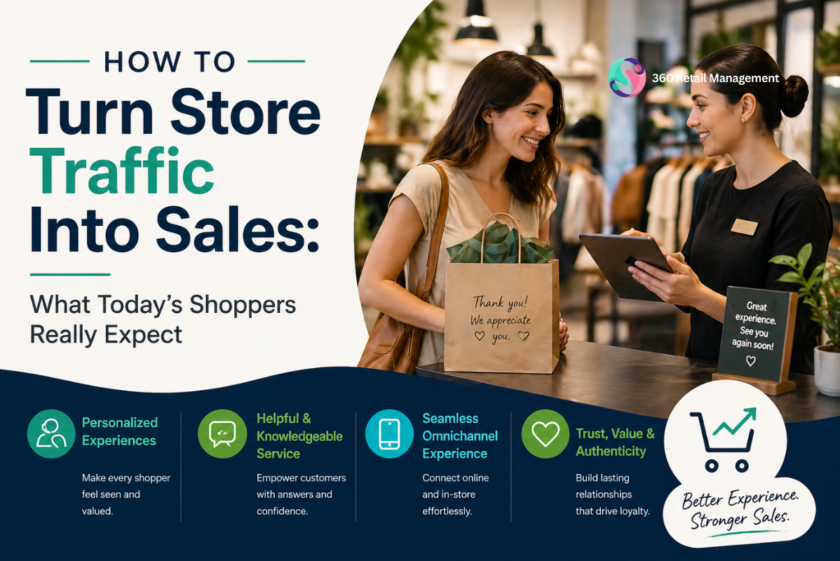
How to Turn Store Traffic Into Sales: What Today’s Shoppers Really Expect
Foot traffic is hard-won. Whether it comes from a well-targeted Instagram campaign, a loyalty program, or word of mouth, getting shoppers through the door is only half the battle.
The real challenge and opportunity is conversion.
And here’s the reality. Most retailers are underperforming. Average in-store conversion rates hover around 3 percent, while online cart abandonment reaches nearly 78 percent. Shoppers are engaging but not committing.
So what’s missing?
The Bar Has Been Reset by Digital
Today’s shoppers do not separate online and offline experiences. They compare them.
Digital channels have trained consumers to expect relevance. Personalized recommendations, tailored offers, and seamless journeys are now standard. According to McKinsey’s Next in Personalization, 71 percent of consumers expect personalized interactions, and 76 percent feel frustrated when they do not get them.
In-store, that frustration does not show up as complaints. It shows up as lost sales.
If your store experience feels generic, you are already behind.
Personalization Is Now a Conversion Driver
Retailers winning today are the ones making shoppers feel recognized, not just served.
The Salesforce State of the Connected Customer highlights that 81 percent of customers prefer brands that offer personalized experiences, and 70 percent expect staff to understand their purchase history and preferences.
This is not about adding more tech. It is about using the right data at the right moment.
Leading retailers are equipping store associates with:
- ✅ Real-time product insights
- ✅ Customer purchase history
- ✅ Smart recommendations powered by AI
This shift turns store teams from transaction handlers into conversion drivers.
A strong example comes from the Aesop case study by StoreForce, where data-driven staffing and operational alignment helped increase conversion from 49 percent to 53 percent without increasing labor hours.
Better decisions, not bigger teams, drive higher sales.
Omnichannel Is No Longer Optional
The modern shopper is omnichannel by default.
According to insights from the NRF Retail Trends and Shopify’s POS-powered personalization report, 73 percent of shoppers use multiple channels during their buying journey, and retailers with strong omnichannel strategies retain up to 89 percent of customers.
Yet many stores still operate in silos.
If a customer browses online and walks into your store:
- ✅ Do your associates know what they viewed
- ✅ Can they continue the conversation seamlessly
If not, you are introducing friction. Friction reduces conversion.
Services like BOPIS are no longer optional. As highlighted in BizTech’s NRF 2025 coverage, unified commerce is redefining stores as connected experience hubs, not just transaction points.
Speed and Simplicity Win at the Point of Purchase
Shoppers abandon purchases at the first sign of inconvenience.
Online, it is shipping costs or checkout friction.
In-store, it is:
- ✅ Long billing queues
- ✅ Unavailable products
- ✅ Uninformed staff
One of the biggest and most fixable conversion killers is being out of stock.
Retailers are increasingly turning to AI-powered inventory systems that combine sales data with demand signals to improve replenishment. Insights from the NRF 2026 trends show that operational precision directly impacts conversion rates.
If the product is not available, nothing else matters.
The Human Element Still Closes the Sale
Technology enables conversion. People finalize it.
Today’s shoppers, especially Gen Z and millennials, are seeking interactive and guided retail experiences. According to VML’s NRF 2026 insights, human connection remains central even in an AI-driven retail environment.
Customers want confidence in their decisions.
That comes from:
- ✅ Knowledgeable staff
- ✅ Genuine recommendations
- ✅ A frictionless in-store journey
What This Means for Independent Retailers
If you are investing in marketing to drive traffic but not seeing sales grow, the issue is not demand. It is executed inside the store.
Independent retailers often lose sales due to disconnected systems, limited visibility into customer behavior, and manual processes that slow down decision-making. These are solvable problems.
If you want to increase conversion without increasing foot traffic, the focus should be clear. You need better inventory accuracy, stronger in-store visibility, and tools that help your team engage customers with confidence. Even small improvements in these areas can significantly increase revenue per visitor.
This is where structured retail support becomes critical. Instead of trying to manage systems, data, and store operations separately, retailers who centralize these functions see faster results and more consistent growth.
How 360 Retail Management Helps
At 360 Retail Management, we work with independent retailers to turn store traffic into measurable sales growth.
We help you:
- ✅ Implement practical AI-driven personalization
- ✅ Improve inventory accuracy and replenishment
- ✅ Connect your online and in-store experience
- ✅ Equip your staff with real-time insights that drive conversion
The goal is simple. Help you sell more with the traffic you already have.


