
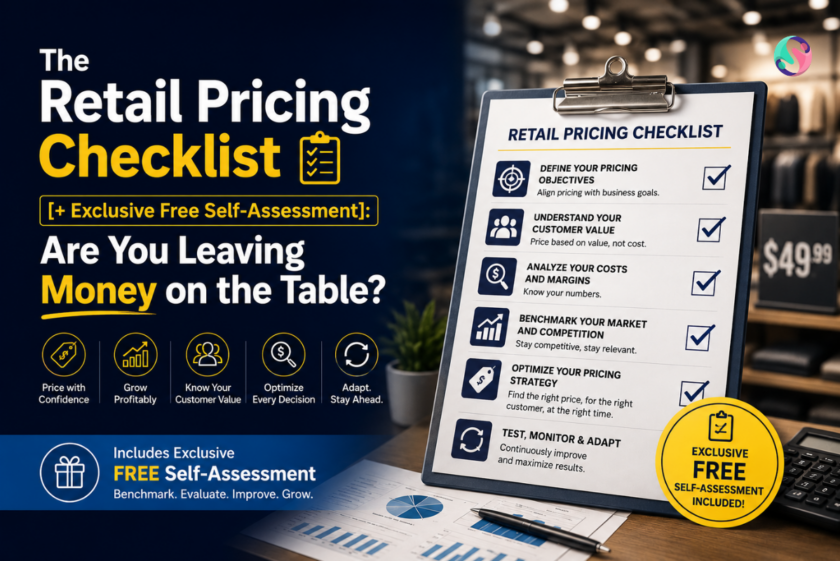
The Retail Pricing Checklist [+ Exclusive Free Self-Assessment]: Are You Leaving Money on the Table?
Walk through your store today and ask yourself: when did you last review your prices? If the answer is “when I opened” or “sometime last year,” you’re almost certainly leaving money on the table — and possibly bleeding profits without realizing it.
Pricing is the single highest-impact variable in your business. A 1% improvement in price realization can boost operating profit by 8–11%, according to McKinsey research. Yet for most independent retailers, pricing still runs on gut instinct, outdated spreadsheets, and a reluctance to rock the boat with customers.
Let’s fix that.
1. Are You Pricing on Value — Not Just Cost?
The most common trap independent retailers fall into is cost-plus pricing: calculate what a product costs, add a standard markup, and done. It’s simple, but it’s often wrong.
“Set your prices based on your customers’ perceptions of value,” advises Steve McLaren, a business adviser with the Small Business Development Center. “When your customers perceive your products to be of good value, sales go up and your profits thrive.”
A specialty kitchen store in Austin discovered this the hard way. After years of pricing imported ceramic cookware at a standard 40% markup, the owner raised prices by 18% and rewrote her in-store signage to emphasize the artisan sourcing story. Sales held steady — and her margin jumped significantly. Customers weren’t buying a pot; they were buying the story.
Are there products in your store where customers clearly see exceptional value, but your price doesn’t reflect it? If shoppers are raving but margins are thin, you have a pricing opportunity.
2. Do You Have a Tiered Pricing Structure?
Single price points for every item in a category are a margin killer. Research from pricing strategy firm Pricing Solutions found that introducing a premium tier often pushes the majority of customers toward the mid-range option — lifting average transaction value without losing volume.
In one well-known study, when shoppers were offered two beer options at $1.80 and $2.50, 80% chose the more expensive one. The presence of the lower price simply made the higher one feel like a better value. When a super-premium option was added at $3.40, most customers gravitated toward the middle — but overall revenue per transaction climbed.
The takeaway for retailers: offer good, better, and best. Whether it’s gift baskets, home goods, or apparel, tiering gives customers permission to trade up — and many will.
3. Are You Reviewing Prices Regularly?
Many business owners set their prices once and never look back — and that’s one of the quietest ways to watch margins erode. Costs change. Your supplier raises wholesale prices. Freight goes up. Minimum wage in your state increases. If your shelf prices haven’t moved in 12 months, your real margin has quietly shrunk.
The hesitation is understandable. Business owners fear that raising prices will trigger a customer revolt. But the reality, as pricing advisers consistently point out, is that habitually small, incremental price adjustments condition customers to change far better than a sudden large jump. Build a quarterly price review into your calendar. Even a 2–3% adjustment across select categories — communicated confidently — rarely triggers the customer exodus retailers fear.
4. Are You Accounting for Every Cost?
One of the most overlooked pricing errors is failing to include every business expense in the calculation. It’s easy to focus on the cost of goods sold while forgetting overhead: rent, utilities, shipping, labor, and marketing all belong in the equation.
For independent retailers, this also includes credit card processing fees (typically 2–3% per transaction), shrinkage, markdowns, and — critically — the cost of your own time. If you’re paying yourself below market rate to keep prices “competitive,” your pricing model is subsidizing your customers at your personal expense.
5. Are You Competing on Price Against Retailers You Can’t Beat?
“Only one company can be the cheapest — everyone else in that race is a loser,” warns Oliver Banks, retail transformation expert and author of Driving Retail Transformation. “Retailers must focus on pricing strategy — not just lowering prices. The key is understanding price elasticity and using promotions strategically to drive profitability — not just volume.”
You will never out-price Amazon or Walmart. But you can out-experience, out-service, and out-curate them. Independent retailers who compete on price alone are playing a game that’s already over. Those who compete on value — expertise, community, curation, personal service — can command a premium and hold it.
6. Are You Tracking What Your Promotions Actually Cost You?
Discounts feel like a customer service tool. They’re actually a marginal decision. One poorly judged markdown campaign can destroy months of carefully built brand positioning.
Before running a sale, calculate the actual margin impact. A 20% discount on an item with a 40% gross margin doesn’t just trim your profit — it nearly halves it. Before the next promotion, ask yourself: is this bringing in new customers, clearing genuine dead stock, or simply training your regulars to wait for the next sale?
How Does Your Pricing Stack Up? Take the 6-Point Self-Assessment
Use the interactive checklist below to score your current pricing practices. Each item is worth one point. Your score will tell you exactly where you stand — and where the opportunity is.
Your retail pricing self-assessment
Check every statement that applies to your business right now. Your efficiency score updates instantly.
Pricing strategy is just one piece of the puzzle. If your assessment revealed gaps — or if you’re ready to take a more comprehensive look at how your store operates — 360 Retail Management can help. We work with independent retailers across the US to build sharper pricing models, stronger margins, and more resilient businesses from the ground up. No cookie-cutter advice — just hands-on consulting built around your store, your customers, and your goals.


